
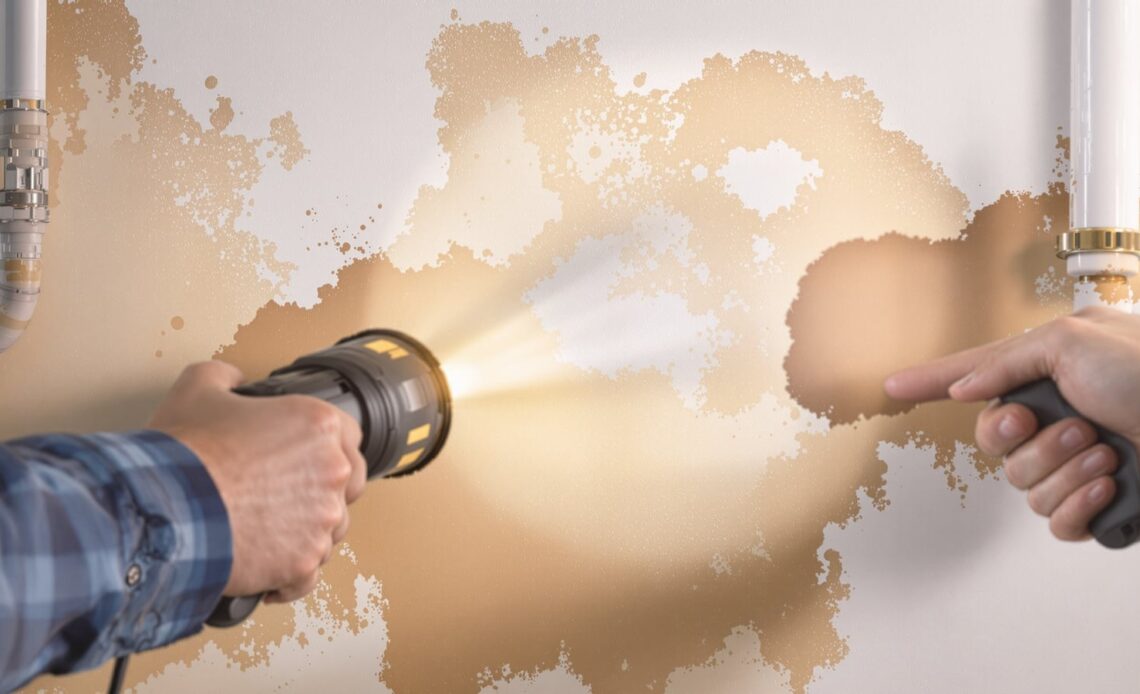
Finding a leak that has no visible entry point is closer to detective work than plumbing, relying on a sequence of tests that narrow down a hidden source step by step. A water leakage specialist combines several detection methods rather than relying on a single tool, since no single test reliably confirms a source on its own in every situation encountered. Understanding this process helps property owners see why a proper assessment takes longer than a quick visual look.
Starting With a Visual Inspection
Every assessment begins with a careful visual inspection of the affected area and its surroundings, noting the exact pattern of staining, its shape, and how it has changed since it was first noticed by the occupant. This initial read narrows down the likely zone of investigation considerably before any equipment is even brought out, since the shape and spread of a stain often hints strongly at which direction the water is actually travelling from.
Using Moisture Meters to Map the Area
A moisture meter measures relative dampness across a surface, allowing a specialist to map exactly how far moisture has spread beyond the visible stain and identify where the reading is strongest. The point of highest reading is often, though not always, closest to the actual source, giving the investigation a clear direction to pursue with further testing rather than continuing to guess at random locations nearby.
Thermal Imaging for Hidden Moisture
Thermal cameras detect subtle temperature differences on a surface, and damp areas typically read cooler than the surrounding dry material due to evaporative cooling happening at the surface itself. This method is particularly useful for tracing water travelling behind tiles or within a cavity wall, where a moisture meter alone cannot reach without physically opening up the structure first to gain direct access.
Dye Testing for Plumbing Sources
Where a plumbing source is suspected, a coloured dye can be introduced into a specific pipe or drain, then checked for at the point where a leak is appearing to confirm whether that particular line is actually the culprit. This method quickly rules out or confirms specific pipe runs without requiring invasive excavation, saving considerable time compared with opening up multiple sections of wall purely on suspicion.
Water Testing on Suspected Membrane Failures
For suspected membrane failures, a controlled water test involves ponding water on a specific section of a roof or wet area and observing exactly where it reappears inside, confirming the precise failure point along the membrane. This method is slower than moisture mapping alone but produces the most direct confirmation available for a suspected membrane issue. Comparing this against water leaking repair shows how each detection method actually maps to a specific likely cause.
Why Multiple Methods Are Often Combined
A single test rarely tells the whole story, since moisture readings might narrow a zone while thermal imaging confirms a cavity path, and dye testing separately rules out a nearby pipe run entirely. Combining methods builds a level of confidence that no individual test could provide alone, which is exactly why a proper assessment takes considerably longer than simply looking at a stain and guessing, though the extra time invested upfront is what actually prevents a wasted repair later.
Documenting Findings for the Property Owner
A specialist assessment should conclude with a clear written record of what was found, which tests confirmed it, and what the recommended repair actually involves, rather than a verbal summary that is easy to forget or misquote later. This documentation becomes particularly valuable if the finding needs to be shared with a management corporation, an insurer, or a neighbour with a competing claim about responsibility.
How Long a Proper Assessment Usually Takes
A straightforward case involving a single clear source might be confirmed within an hour or two, while a more complicated case involving multiple suspected causes or difficult access can take considerably longer to properly resolve. Property owners are often surprised by how much time proper detection actually requires, having assumed a leak assessment would resemble a quick plumbing callout rather than a genuinely methodical investigation.
When Access Becomes Necessary
Occasionally, non-invasive testing narrows the source but cannot confirm it precisely without opening a small section of wall, tile, or ceiling to physically inspect the suspected point directly. A good specialist keeps this access as limited as reasonably possible, guided by everything the earlier testing has already indicated about the likely source. Reviewing waterproofing for roofs also helps decide what should replace the material removed during this access.
What This Process Means for the Repair That Follows
A repair based on confirmed findings rather than assumption is far more likely to actually resolve the problem the first time, since every step of the detection process exists specifically to remove guesswork from the final decision. Property owners who understand this process tend to trust the eventual recommendation more readily than one delivered without any visible investigation behind it, and are also less likely to question the cost once they have seen the actual work involved.