
How to Compare Nearby Towns Before Buying a Home in New Canaan, ConnecticutKey Takeaways
- The town you choose can affect daily life as much as the home itself, including commute times, services, road access, and ongoing costs.
- Compare New Canaan with nearby communities based on your actual priorities, such as walkability, privacy, outdoor space, transportation, and housing style.
- Set clear priorities and identify nonnegotiable needs and deal breakers before scheduling tours.
- Calculate the full cost of ownership, including mortgage payments, property taxes, insurance, utilities, maintenance, and expected renovations.
- Review the exact property tax bill for each home instead of relying on town-wide estimates.
- Test commutes during realistic travel periods and consider parking, traffic, winter conditions, and backup routes.
- Consider the maintenance responsibilities associated with older homes, larger lots, pools, private roads, wells, and septic systems.
- Visit each town at different times to assess traffic, walkability, parking, noise, and access to everyday services.
- Confirm school assignments and investigate utilities, permits, zoning, wetlands, conservation restrictions, and historic-district requirements for the specific property.
- Use a town scorecard to compare affordability, transportation, housing options, convenience, and potential deal breakers.
When buying in New Canaan or the surrounding Lower Fairfield County communities, the town you choose can influence your routine just as much as the house itself. A beautiful property may look ideal online, yet its commute, utility setup, road access, tax bill, and distance from everyday services can make it a poor fit over time. Buyers comparing New Canaan with Darien, Rowayton, Greenwich, Westport, Southport, and nearby areas can benefit from local guidance before narrowing their home search. New Canaan, CT, real estate agent Rachel Walsh is a local real estate advisor whose website offers neighborhood information, home-search tools, valuation resources, and market guidance for New Canaan, Darien, Rowayton, and Lower Fairfield County. Rachel Walsh’s experience across these communities can help buyers frame better questions about housing styles, location, and long-term fit.
Why the Town Matters as Much as the House
A home purchase is not limited to the rooms inside the property line. It also includes the roads you use, the services you rely on, the time required for errands, and the costs that continue long after closing. Two homes with similar prices can create very different ownership experiences when one has higher taxes, a longer drive to the train, a private septic system, or extensive grounds to maintain. In Lower Fairfield County, the contrast can be especially noticeable. One buyer may value a walkable village setting and quick access to shops, while another may prefer a larger lot, greater privacy, and room for outdoor living. Neither preference is wrong. The goal is to identify which town best supports your actual lifestyle, rather than choosing solely based on listing photos or square footage.
Start With a Clear List of Priorities
Before scheduling tours, write down the factors that will affect daily life. Rank them in order of importance, then choose three nonnegotiable needs and three deal breakers. This simple exercise helps prevent attractive finishes or staging from distracting you from practical concerns.
- Travel time to work, school, family, and regular appointments
- Access to rail stations, highways, and alternate driving routes
- Walkability to shops, restaurants, parks, and community services
- Lot size, privacy, and maintenance expectations
- Preferred home style, age, layout, and renovation tolerance
- Access to beaches, trails, playing fields, and other recreation
- Proximity to medical care, grocery stores, pharmacies, and childcare
Compare the Full Cost of Living
The listing price is only one part of a realistic home budget. Compare the expected mortgage payment with property taxes, homeowners’ insurance, utilities, routine maintenance, and any renovations likely to be needed after purchase. Larger yards may require landscaping or snow removal. Pools may require seasonal service. A home on a private road, with a well or a septic system, can also bring responsibilities that differ from those of a home connected to municipal systems. Property taxes deserve property-specific attention. Connecticut municipalities use mill rates, with one mill equal to $1 in tax for every $1,000 of assessed value. Because tax assessments and rates can vary, ask for the exact current tax bill for each property instead of relying on a broad town-wide estimate. Include that amount in your monthly ownership calculation before deciding whether a home is comfortably affordable.
Test the Commute in Real Conditions
A map estimate is a useful starting point, but it is not a substitute for experiencing the route. Drive from each town to work, school, medical appointments, train stations, and regular errands at the times you would actually travel. Notice parking availability, traffic patterns, winter road conditions, and whether there are practical backup routes. A 10-minute difference each way may seem minor during a single showing. Over five workdays, however, that adds 100 minutes of travel time each week. For buyers who commute regularly, that recurring time commitment may matter more than an extra bedroom or a slightly larger yard.
Look at the Housing Mix and Maintenance Profile
Each community has its own mix of single-family homes, condominiums, townhomes, historic residences, newer construction, waterfront properties, and larger-lot homes. The available housing stock should align with both your current budget and your likely next chapter. A buyer seeking minimal exterior maintenance may prefer a condo or a newer home. At the same time, someone who values mature landscaping and architectural character may be comfortable with an older property and its upkeep. Consider the trade-offs honestly. More space can mean more utility usage, cleaning, repairs, and outdoor work. A smaller home near daily services may offer convenience that offsets a reduced footprint. Look beyond the number of bedrooms and ask how each property will function on an ordinary Tuesday evening.
Measure Everyday Convenience
Visit each town more than once and at different times. A quiet Sunday afternoon does not reveal weekday traffic, school pickup activity, commuter parking, or the pace of a town center. Walk around when possible, stop at a grocery store or coffee shop, and observe sidewalks, lighting, noise levels, road conditions, and the overall ease of getting around.
- Visit during a weekday morning and evening.
- Check the distance to groceries, pharmacies, libraries, and medical offices.
- Notice parking, sidewalks, intersections, and pedestrian activity.
- Consider how the area may feel during storms, busy summer weekends, or winter weather.
- Decide whether you prefer a lively center, a quieter residential setting, or a blend of both.
Review Schools, Services, and Property Systems
Buyers with school-related needs should confirm assignments using the exact property address, rather than assuming every home in a town is served by the same schools. It is also wise to investigate childcare options, recreation programs, libraries, emergency services, and transportation choices that matter to your household. At the property level, determine whether the home uses public water and sewer or a private well and septic system. Review available permits and records, and consult appropriate professionals regarding inspections, zoning, wetlands, conservation restrictions, or historic district requirements. These details can affect renovation plans, maintenance responsibilities, and future buyer interest.
Build a Simple Town Scorecard
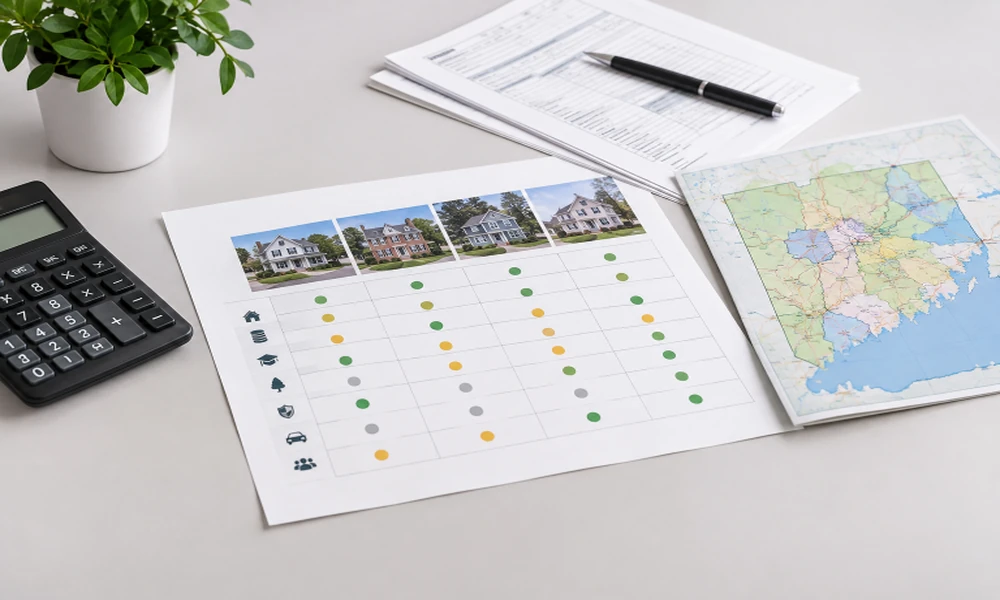
A scorecard keeps the search focused when several towns appeal to you. Start with three or four communities that generally fit your price range. Give each one a score from one to five for the categories that matter most, then write a short note explaining the score.
- Rate commute and transportation access.
- Rate monthly affordability, including taxes and expected upkeep.
- Rate housing options, condition, lot size, and future flexibility.
- Rate services, recreation, walkability, and everyday convenience.
- Mark deal breakers such as flood concerns, limited inventory, or an impractical commute.
Revisit the scorecard after touring homes in person. A town that felt perfect on paper may not feel right in practice, while another may become more compelling once you understand its streets, housing options, and daily rhythm.
Questions Buyers Commonly Ask
How many towns should buyers compare?
Starting with three or four towns usually provides a useful contrast without feeling scattered. Expand or narrow the list as your priorities become clearer.
Should buyers focus more on price or property taxes?
Both matter because the best comparison is the complete monthly and annual ownership cost. Include financing, taxes, insurance, utilities, maintenance, and likely repairs.
Is a larger home always a better choice?
No. A larger home may provide flexibility, but it can also bring higher operating costs and more maintenance. The better choice is the home-and-town combination that sustainably fits your needs.
Final Checklist Before Choosing a Town
- Confirm a comfortable monthly housing budget.
- Review the exact property tax bill for each serious option.
- Test commutes during realistic travel periods.
- Visit each town multiple times during the day.
- Compare local services, transportation, and recreation.
- Review utility systems, zoning, flood exposure, and maintenance needs.
- Consider how the town could fit future lifestyle changes.
The best town is not automatically the one with the lowest price or the largest house. It is the place that supports your budget, routines, priorities, and plans. Comparing nearby New Canaan-area towns with a clear process can make the search more efficient and lead to a decision that feels right well beyond closing day.